Angolan Civil War
Another Day of LifeThe Angolan Civil War began as Angola approached independence and became a struggle among armed political movements for control of the country. In Ryszard Kapuściński’s account, the war is not confined to fronts and battlefield communiqués: it empties Luanda, unsettles the people trapped there, and continues long after foreign forces leave. Its course is marked by a deepening divide between confident public claims and an increasingly precarious reality.
Background and competing forces
The conflict was already under way in the spring of 1975, after Portugal’s new rulers granted Angola and the other former colonies the right to independence. Armed parties fought for power, with the struggle described as cruel and uncertain; people could not know who might meet death, or where. As the fighting spread, those able to leave fled, while Kapuściński, then a correspondent for the Polish Press Agency, persuaded the crew of one of the last Portuguese military aircraft bound for Angola to take him to Luanda.
Comandante Ndozi placed the current war within a much longer history of conquest, forced migration, and social division. He described centuries of Portuguese campaigns and slave trading, and a country whose population had been depleted by the capture and export of people. In his account, communities often defined the limits of their world by the last village whose language they understood; people beyond that boundary could be regarded as alien. He argued that political enemies exploited such divisions, associating Holden Roberto’s FNLA with the Bakonga and Jonas Savimbi’s UNITA with the Ovimbundi. The challenge, as he framed it, was to make a nation from many communities and to displace inherited hostility with the practice of cooperation.
Ndozi also described the immediate military imbalance as a human and material predicament. The MPLA had few experienced cadres at the front, while young recruits were taken from school to serve in a war they had not chosen. Angola, he said, was rich in oil and diamonds but inhabited by millions of poor people, and its opponents expected a small force of armoured vehicles to secure those resources. His account makes the conflict a contest over political power and wealth, but also a forced interruption of education and civilian life.
Luanda under pressure
The war’s effects in the capital unfolded through fear, departure, and the failure of ordinary services. In September, an unmarked plane dropped leaflets claiming that Holden Roberto’s army would soon enter Luanda and urging people to kill Eastern Europeans alleged to be directing MPLA forces. Kapuściński noted that he was the only person from Eastern Europe in Angola at the time. With no functioning authorities to restrain them, PIDE gangs searched for hotel residents, making each knock at his door a source of danger.
The city’s decline was not initially presented as a scene of widespread physical destruction. Instead, Luanda was drained of its population and capacity to function. Portuguese residents arrived from across the country in overloaded cars and gathered first in hotels, then at the airport when rooms ran out. A makeshift settlement grew there in the rain. The crowd struggled over who should be given seats on departing planes; women with children sometimes blocked aircraft from taxiing, and soldiers intervened to reorganize boarding. The air bridge was expected to carry half a million refugees away.
As October began, water grew scarce because pumping stations stood near the front and were repeatedly destroyed after repairs. Shops, restaurants, and cafés closed. Then residents learned that the police had left, leaving the city without its regular force. The abandonment extended even to municipal work: after the garbage collectors departed, rubbish accumulated in streets, squares, and market areas. With hospitals and pharmacies no longer open, the remaining inhabitants faced the consequences of a city whose services and institutions had receded along with its population. These changes show how the conflict reached civilians without requiring a battle in every street: the withdrawal of workers, police, and basic services made everyday survival increasingly uncertain.
Battles and competing accounts
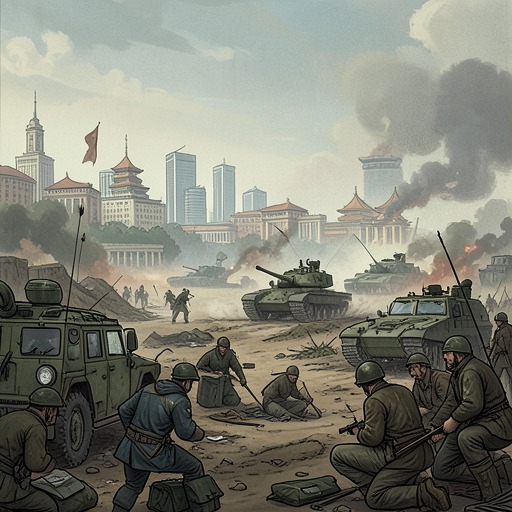
The fighting around Caxito offers a specific measure of the changing front. More than sixty kilometres north of Luanda, Comandante Ndozi’s unit seized the town from the FNLA after a battle at dawn. The political commissar of the MPLA general staff, Comandante Ju-Ju, announced military developments in a nightly radio communiqué. His accounts could cast setbacks and engagements in grand language, while the form of the broadcasts itself offered Kapuściński a rough signal of how the front was going: when events appeared favourable, the reports were brief; when matters went badly, they grew longer and more heavily embellished.
That discrepancy became consequential as the danger to the capital increased. In November, Holden Roberto announced that he would enter Luanda, and artillery fire beginning at dawn prompted panic in the city. Yet Ju-Ju’s communiqué remained optimistic even as Kapuściński understood that half the country was in enemy hands. The contradiction between appeals to defend the city and assertions of imminent success risked blunting urgency and undermining trust. The war was therefore fought not only through armed advances, but through attempts to shape what people believed about those advances.
On 11 November 1975, Agostinho Neto proclaimed the People’s Republic of Angola in Luanda. Kapuściński’s dispatch described the country as provisionally divided into two states, with complicated borders changing almost every day. The diplomatic contest over Angola had begun, but his report stressed that the fighting was intensifying and both sides were growing stronger. Independence brought a new political declaration, not an end to the conflict or an agreed settlement over who governed the country.
A war that outlasts its first phase
The conflict continued from 1976 through 2000, becoming one of the longest-running armed conflicts in the contemporary world. The book notes that Cuban and South African forces had departed, but Angolans remained in a country divided and devastated by civil war. For three decades, the central government faced the rebellion of Jonas Savimbi. The resources that had formed part of the war’s stakes also helped sustain it: the government drew revenue from oil, while Savimbi controlled substantial diamond resources.
The account estimates that perhaps a million people had died by the time of its retrospective, with millions more still alive and the number of victims likely to grow. The human consequences also appear in the uncertain fates of people encountered earlier in the narrative. Comandante Ndozi was later killed by a mine. Kapuściński could not say what became of several others, reflecting how people could disappear from both the country and the record of those who had known them.
The war’s ending is thus not a clean return to peace. Foreign departures altered the military landscape, but they did not reunify the country or end the contest for power. The narrative links changing front lines to a wider pattern of institutional collapse, displacement, and political separation, then follows that pattern beyond the declaration of independence. Its final measure is the persistence of the conflict: Angola remained divided, while the war and its losses continued to shape the lives of those still there.